

Phases of Construction Project | Complete Guide by PISL for 2026
The term ‘construction‘ itself denotes not only the mere joining of bricks and cement, but a well-ordered and controlled operation that brings a fantasy to reality, and the resulting structure is usable.
The phases of construction project, whether it is a residential area, a large commercial building, or a massive industrial site, are crucial to management, cost estimation, and execution without disruption.
In this manual, we present the stages of a construction project clearly and logically, thus making it easier for professionals, developers, and learners to comprehend how a project evolves from idea to finished product.
PISL has been a construction contracting company with over 16 years of experience. It has worked on the construction of complex projects in the fields of industry and logistics infrastructure throughout India.
The company has mastered discipline in planning, ensuring smooth execution and quality throughout every building construction project it handles for its clients. Thus, its strength lies in these activities.
What is a Construction Project?
A construction project presents a well-organized approach for creating physical infrastructure. This infrastructure consists not only of residential buildings but also includes offices, factories, and other business establishments.
It requires a team effort where everyone, from end users to construction supervisors, contributes to a project and gets involved at different points throughout the process.
The project process in the construction industry involves an orderly and systematic approach to following the various stages that assist in achieving the objectives of safety, quality, cost, and regulatory compliance, as well as the punctual delivery of the project.
The following stage is always an extension of the preceding stage; therefore, there is a significant amount of planning required for the project’s success.
You may also like – Key Challenges in Industrial Construction & How to Overcome Them?
1. Pre-Construction Phase – Laying the Strategic Foundation
Pre-construction is the initial and most crucial stage of a construction project. Pre-construction involves the collaboration of multiple teams to convert conceptual ideas into concrete plans and strategies. Construction Project Management – Pre-construction
Major activities consist of:
1. Concept and Feasibility Analysis
Stating project objectives unambiguously and verifying if the whole thing is feasible in terms of technology and money
2. Budget Planning
Estimating future costs for supplies, workforce, permits, and unforeseen expenses so that there are no surprises later
3. Site Analysis
Gaining site knowledge through the investigation of soil types, topography, accessibility, and possible environmental issues
4. Design Brief Finalisation
Merging the client’s dream with the architects’ and engineers’ concepts for a proper project roadmap
This phase clears up doubts and prevents costly alterations during subsequent stages.
2. Design Phase – Realization of Vision in Techno-Functional Formulas
Technical
The building stage in the project entails ensuring the project’s feasibility from the outset. The primary goals of the building stage include transforming ideas into detailed plans and specifications.
The key components are as mentioned below:
1. Schematic Design
At this stage, we focus on the preliminary layouts and space arrangement. We conceptualize the design of the area.
2. Detailed Design Development
At this stage, it is already possible to envision the completed building, along with its surroundings, clearly. The distribution and character of the floors, as well as the size and temperament of the rooms, have already been considered and chosen, even if the final stage is linked to a combination of internal and external characteristics of a building’s facade and colors.
3. Approvals and Permits
The design team is required to submit the plans regarding the entire building project to the concerned municipal authority. After the design work is completed, the whole staff, including the team of architects, engineers, and project managers, will work overtime to approve the draft codes.
3. Procurement Phase – Sourcing Resources and Partners
The procurement process provides a platform for procuring all construction items, whether they be materials, equipment, or services, in an efficient manner.
The areas of concern to be considered in this stage are as follows:
1. Material Selection
Let us embark on this road towards achieving the optimum balance of quality, price, and availability. Our ultimate goal is to enjoy all three fully.
2. Vendor/Subcontractor Finalization
I eagerly look forward to discussing the time frames and costs with you so that we can execute without any glitches.
3. Contract Agreements
Making our terms and conditions, including those related to legal, business, and delivery, explicit is a marvelous starting point for each of us.
An effective procurement process integrates the various stages of a construction process with time and money.
4. Construction Phase – Executing the Building Construction Project
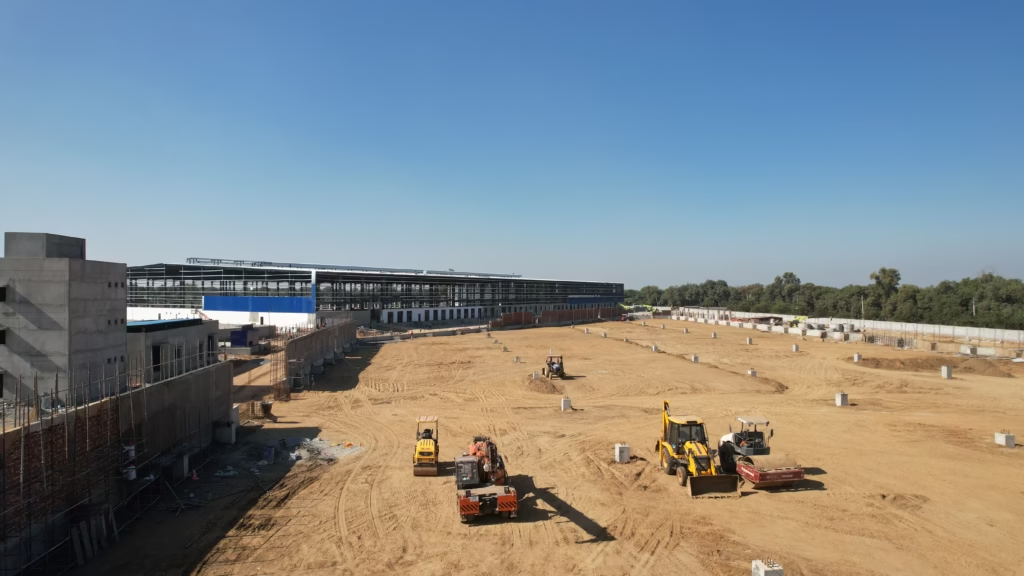
This construction stage can be identified as the most observable and, consequently, the most resource-intensive in the construction project process. This involves rendering the plans tangible.
The primary activities are as follows:
1. Site Preparation
They seize the land, dig the site, and construct a base.
2. Structural Construction
There is construction work involving the erection of columns, beams, floors, walls, and roofs.
3. Electrical Network and Utility Installation
The installation team provides electrical, plumbing, firefighting, and air conditioning systems.
4. Finishing
The final work is complete for the floors, wall finishes, doors, windows, and external landscaping. Efficiency in project management is one of the most crucial elements in ensuring that the safety and time control mechanisms in this phase of the project are effective.
5. Commissioning and Handover – Ensuring Project Readiness
As construction concludes, we move into commissioning and handover with excitement!
Main activities are as follows:
1. System Testing
The evaluation of various systems’ structural, mechanical, and electrical components is performed to ensure safety and functionality.
2. Inspections and Snag Rectification
The objective is to identify and correct all minor issues so that everything functions optimally.
3. Client Walkthrough and Documentation
We take this opportunity to provide our clients with a walkthrough and offer them any necessary manuals or documentation to ensure a seamless transition to support.
This stage of the construction process ensures the structure is in a state conducive to being occupied by people.
6. Post-Construction Phase – Long-Term Performance and Support
It differs from the more general intention of ensuring success in the post-construction phase, encompassing both the post-completion ability and the quality of the building.
So the post-construction phase includes the following steps:
1. Maintenance Planning
Regular checkups and scrupulous checks to ensure the proper functioning of all parts.
2. Performance Appraisal
Assessment of the system’s effectiveness to ensure that these are user-friendly.
3. Assurance & Liability of Defects Support
Assist in resolving any issues that may arise during the warranty period, thereby ensuring the customer feels secure and can utilize the product to its full capacity.
We are committed to ensuring that user satisfaction and value will always remain a top priority and will be consistently exceeded over time.
Conclusion on the Phases of Construction Project
Each level of the construction work had to be unique, well-organized, and well-managed. At every level, whether it is the agreement, the design concept, the construction phase, or the maintenance phase, each plays a vital role in the overall success of the process.
Every level of the process will be well-organized, predictable, and non-exhausting to all parties involved if it is well-managed.
With a clear understanding of the construction process, it will now be possible for all those involved to foresee any challenges associated with the process. It will take a considerable amount of time to break down all these tasks.
However, all projects will have a direction. The process of undertaking all activities will lead to the development of structures that are safe for all those who need them. All structures will be secure as a result of the above process.