

Role of Technology in Modern Warehouse Construction
Gone are the days when fulfillment centres were tired dark spaces carrying boxes- they are futuristic counterparts plucked straight out of Inception, breaking away from traditional shackles.
Innovation alone translated from conventional warehouses to the contemporary postmodern and technology-driven hubs. Technology is not just playing a supporting role here. Instead, technology is reinventing the space itself.
Whether you are a businessman looking at setting up a facility, a contractor contemplating trends, or simply oh-so-curious about how logistics will be there in the coming decade, knowing how technology affects the construction of a modern-day warehouse will become more than necessary.
This article will present one perspective on how BIM, prefabrication, sustainable building materials, and data analytics are changing warehouse construction worldwide.
We then attempt to define what a modern warehouse is, provide a few case studies, and then share a few ways PISL Infra is setting the benchmark in India.
What is a Modern Warehouse?
A modern warehouse is never just a place to store products. It is designed with technology, efficiency, and sustainability as added benefits to support operations and maximize productivity.
Typical features of a modern warehouse include:
Innovative Layouts: Optimized floor layouts that lessen travel times and make workflows efficient.
Technology Integration: All sorts of automation setups beyond IoT sensors, robotics, and software applications, allowing for hassle-free operations.
Scalability: The ability to stand in the face of upscaling in business requirements.
Sustainability: Green building materials and energy conservation methods.
If traditional warehouses just stored products, modern warehouses are centers of efficiency that provide fast distribution and excellent customer service.
Also Read – Warehouse Design | Complete Guide
BIM (Building Information Modeling) – Designing Smarter Warehouses
Its most significant technological evolutions in modern warehouse construction are BIM (Building Information Modeling).
Imagine, for once, seeing your warehouse in a 3D model before laying a single brick. BIM precisely provides this by allowing contractors, architects, and clients to work simultaneously on a virtual model and make changes in real-time to rectify potential issues.
Some Advantages of BIM in Warehouse Construction:
- Identifies design flaws or constraints due to space before construction begins.
- Saves costs by foreseeing rework on-site.
- Enhances collaboration among the architect, engineer, and contractor.
- Allows more proficient layout design, workflow, and storage.
For instance, a warehouse may require a particular racking system, which BIM can use to simulate its placement in the warehouse layout.
BIM can also check if forklifts have enough space to move around. This upfront approach makes the entire process more efficient and less error-prone.
Prefabrication & Modular Construction – Building Faster, Smarter
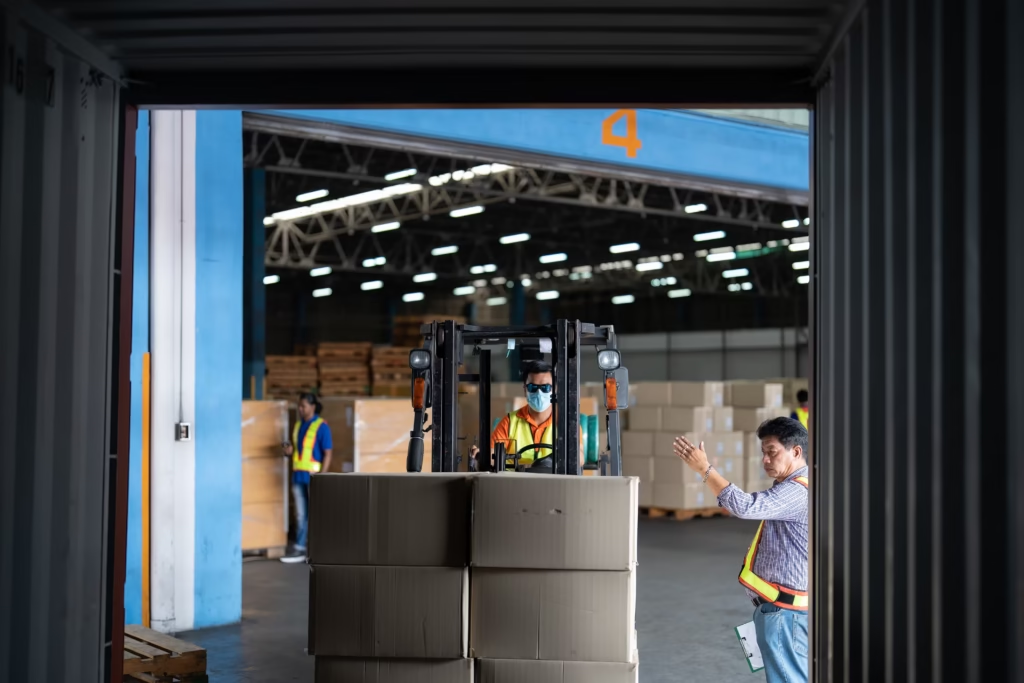
Another trend affecting the contemporary warehouse business is prefabrication and modular construction. Rather than being erected on-site, major components are made in a shop, brought to the site, and assembled.
Advantages of Prefabrication:
Fast: Construction period becomes short.
Accuracy: Minimize human error by manufacturing components in the factory.
Scalable: Sections can be expanded as the business grows.
Cost-Effective: Lower labour costs and less wastage of materials.
Modular warehouses are a godsend for the growing e-commerce players in India. Depending on demand, buildings can quickly increase capacity without halting operations.
This flexibility has led to modular patterns becoming the choice for most modern warehouse constructions in India.
Advanced Materials & Sustainable Solutions – Building for the Future
Sustainability and modern infrastructures have become essential considerations for any development. And thus, modern warehouses are increasingly being built from environmentally friendly, durable, and cost-efficient materials.
Some popular choices are:
- Recycled Steel: Strong steel and light on the environment.
- Energy-Efficient Insulation: Keeps the temperature constant and lowers energy bills.
- Low Emissions Concrete: Less carbon footprint.
- Solar Panels and Skylights: Less dependency on nonrenewable energy.
Why Sustainability is an Important Factor In Warehouse:
- Helps companies meet global ESG (environmental, social, and governance) goals.
- Helps reduce the costs of maintenance and operation in the long run.
- It makes warehouses ready for the future as the regulations for green buildings become stricter.
However, insulation with sustainable materials will significantly improve efficiency and reduce costs for industries that store temperature-sensitive goods such as food or pharmaceuticals.
You may also like – Benefits of Built-to-Suit Warehouse
Data Analytics & Predictive Modeling – Smarter Decisions from Day One
Data is said to be the backbone of every successful modern business, and now it is also setting the mold for warehouses. Data analytics and predictive modeling allow a company to design a warehouse that meets present needs and is ready for future demands.
How Data Construction Aids Warehouses:
Optimised Layouts: These would evaluate which goods are mostly picked and determine direct storage placement.
Cost Forecasting: These would be mistakes in predicting wastes and operational bottlenecks before they occur.
Maintenance Planning: When repairs are needed for equipment or structure, they should be done promptly.
Performance Tracking: Will the facility be able to work to a high standard?
In concrete terms, a warehouse can be designed to meet current requirements but efficiently scale as the company grows.
Modern Warehouse Examples
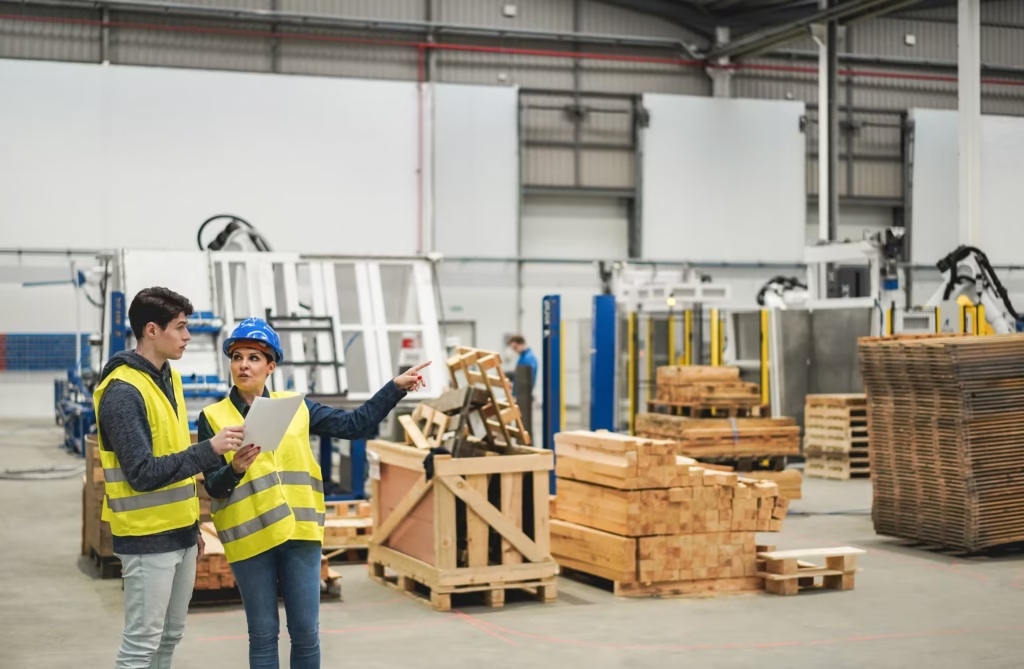
To help understand how these technologies are actually put into use, we can study warehouses around the world:
- Amazon Fulfilment Centres (India & Global): Popular for having picture robots, combining AI, data analytics, and human skill into processes for picking and packing.
- Flipkart Warehouses (India): Using automation and environmentally friendly design to meet the demands of a massive e-commerce operation.
- Bosch Industrial Warehouses: Designed in modular sections with energy-efficient systems for long-term adaptability.
Such instances show businesses investing in innovative, scalable, and green infrastructures to stay competitive.
Why PISL Infra Leads in Modern Warehouse Construction
At PISL Infra, we know warehouses are no longer precast edifices—they are, in fact, the backbone of modern supply chains. Our approach leans into innovation, emphasizing sustainability and precision, to create warehouses that answer today’s needs and tomorrow’s challenges.
Why PISL Is One of Our Clients’ Most Favored Options:
Sustainable Approach: Eco-friendly construction for long-term efficacy.
Technology Integration: BIM uses, modular construction, and data planning.
Experienced Team: Engineers and specialists with numerous years of experience in industrial construction.
Tailored Solutions: From huge logistics parks to specialised facilities, we provide design for your growth.
Be it for advanced technology or practical know-how, PISL Infra, alongside other modern warehouse contractors, remains one of India’s most trusted.
Conclusion on the Modern Warehouse Construction
The modern warehouse construction is the transformative role technology plays in it. These technological services have changed how warehouses are designed, built, and operated, from BIM and prefabrication to sustainable materials and data analytics.
At PISL Infra, warehouses aren’t built; they are future-ready facilities that empower businesses. The team is committed to excellence at all levels, from the smallest of buildings to the largest of distribution centers.
Let us help you build the warehouse of tomorrow: sustainable, scalable, and innovative.
- Call us at: +91 85270 40411
- Mail us at: info@pislinfra.com
Frequently Asked Questions Regarding Modern Warehouse Construction
Below are the answers to the most asked queries on the internet regarding modern warehouse construction.
Q1. What do you consider a modern warehouse?
A modern warehouse is a technology-oriented facility beyond storage, using BIM, automation, and green materials to enhance efficiency, reduce costs, and ensure seamless logistics.
Q2. Give examples of some modern warehouses.
Amazon's automated fulfillment centers and Flipkart's AI-powered distribution hubs are two examples, both meant for massive volumes, speed, and precision.
Q3. What is a modern warehouse in India?
In India, modern warehouses are mushrooming at full speed, with companies like PISL Infra spearheading through innovative construction, intelligent layout, and state-of-the-art technology integration.