

Sustainable Warehouse Construction: Best Practices and Benefits
You can relate the importance of warehouses in today’s supply chains to the dependence of the modern world on the Internet. They are indispensable in the industrial parks and logistics hubs.
Yet, their carbon-based materials and highly energy-intensive systems for lighting, heating, and cooling continue to have a high environmental impact. Thus, the need to build green warehouses is not a trend but an undeniable need.
Companies that implement sustainable policies will not only achieve the needed legal compliance but also earn their customers’ trust, minimize long-term costs, and enhance productivity.
Similarly, a green warehouse uses less power, structures a smoother workflow, and has minimal adverse environmental impacts all simultaneously.
Working with experienced builders ensures that, from design and construction to everyday operations, everything is done in an environmentally friendly manner, paving the way for a clean and bright future on the asphalt road.
Best Practices for Sustainable Warehouse Construction
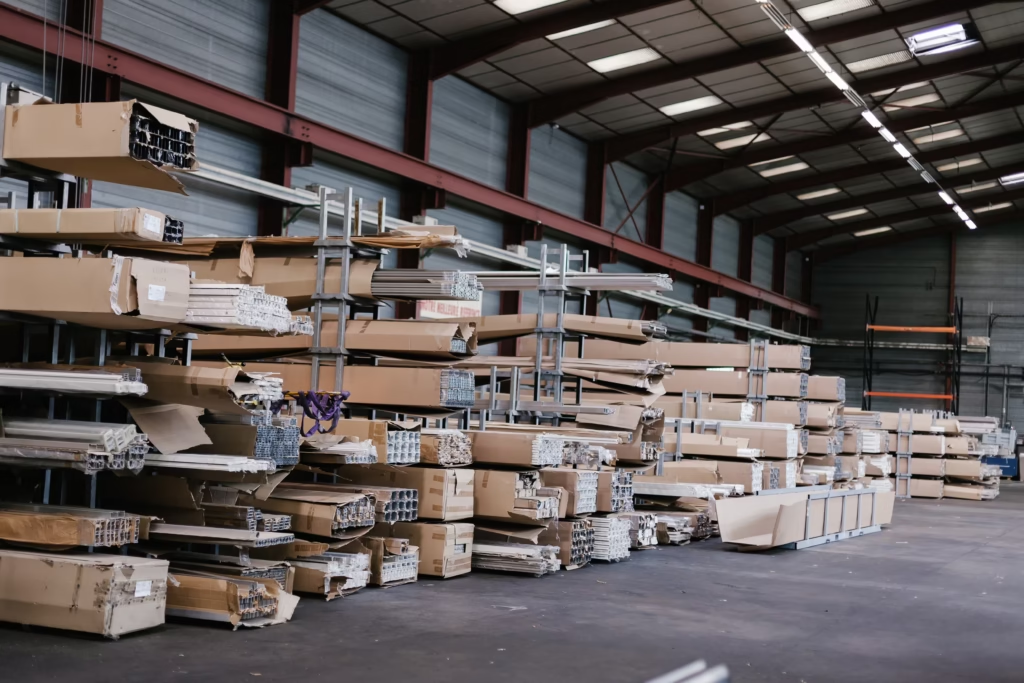
The following are the key ways to make your warehouse sustainable, efficient, and future-ready:
1. Energy Efficiency in Design
Start with an eco-friendly design. Solar panels, skylights, and the use of high-efficiency HVAC systems will reduce electricity consumption. LED lights with motion sensors conserve total energy. The installation of effective insulation helps maintain a constant indoor temperature. These measures result in lower emissions and savings in operating costs.
2. Efficient Layouts
Create layouts that can already be quoted as a description in terms of saving: less time, less fuel, and less energy. Henceforth, the travel distances of goods and vehicles will be shorter, and on top of that, organize the whole flow in such a way that there is no idle time. Efficient movement speeds up the process, reduces emissions, and increases productivity simultaneously.
3. Sustainable Materials
Specify materials that will benefit the environment. For example, using recycled steel, low-carbon concrete, and bamboo as a renewable material can significantly reduce carbon dioxide emissions from your project. Reusing materials obtained on-site and minimizing waste will help extend the building’s lifespan with reduced environmental harm.
4. Built-to-Suit Design
Custom warehouses for your business. The construction of the structure in a way that fits perfectly with the company’s operations not only eliminates waste of space and materials but also ensures the most qualified utilization of resources, leading to better operational efficiency. Additionally, it sets the stage for continuous productivity and environmental sustainability.
5. Water Management
Introduce new water management technologies. Some of the practiced methods include rainwater harvesting, the use of low-flow fittings, and reusing treated water to minimize water usage. These actions will have several co-benefits, including the saving of scarce resources, an increase in regional water resilience, and the promotion of sustainable industrial development.
6. Green Roofing & Landscaping
These include various environmental measures such as the construction of green roofs and planting trees in and around the building. The building, covered with natural elements, is not only insulated but also helps improve air quality, retain rainwater, and reduce the need for cooling. At the same time, it enhances the health of the surrounding environment.
Benefits of Sustainable Warehouse Construction
The investments in sustainability pay off. The following are the main advantages:
Cost Savings: With energy-efficient systems and innovative layouts, combined with renewable energy installations, the operational costs of a facility decrease over time. Hence, reduced utility bills, fewer maintenance surprises, and very long, usually excellent building systems are the main factors.
Improved operational efficiency: achieved through an optimized layout combined with enhanced material flows and streamlined systems, offers the following advantages: faster turnarounds, reduced fuel consumption, and increased throughput.
Improved Brand Image: The attribute of environmental responsibility is an increasingly valued feature for clients, investors, and consumers. This means that the newly built, sustainable warehouse speaks loudly of corporate integrity and technological leadership.
Regulatory Compliance: Many local authorities today are making it compulsory to adapt to the latest tendency towards sustainability in industrial construction. With green buildings, you will not only adhere to regulatory compliance but also avoid the higher costs associated with retrofitting.
Future-Proofing: Sustainability is not a trend; it’s a fundamental shift in business practices. A low-impact, high-efficiency warehouse design positions your business in line with emerging standards, rewards, and market expectations.
The Role of Logistic Parks in Sustainability
The role of logistic parks in making industrial operations more sustainable is enormous. The parks typically offer shared facilities, including renewable energy systems, waste management, electric vehicle charging for fleets, and improved access to roads and rail.
By grouping warehouses into a “green” logistics campus, firms can achieve a sustainability win through increased economies of scale, which in turn leads to a lower cost of infrastructure per unit, shared environmental systems, and optimized site locations for logistics. Everybody wins – both companies and the earth.
Why Partner with PISL?
PISL is an industrial construction specialist with deep credentials in the delivery of sustainability-minded warehouse and logistics park projects. Here’s what stands out:
PISL is India’s largest and most experienced contractor, having built over “12 + million sq ft” of area all over the country.
- It involves the entire project delivery from start to finish, including design, procurement, construction, and commissioning, as part of the service package.
- PISL is committed to sustainability and has earned numerous prestigious awards, including LEED Gold certification for the “Pragati One” logistics park from the U.S. Green Building Council (USGBC).
- Their strategy leverages technology, drives innovation, and provides build-to-suit flexibility, which are essential factors in constructing an efficient, sustainable, and business-aligned warehouse.
In other words, PISL is not just a builder; it’s a partner for sustainable and future-focused logistics infrastructure.
Conclusion on Sustainable Warehouse Construction
In today’s world, the construction of green warehouses is a must-have for the modern industry. Eco-materials use, efficient energy design, and automation are just a few of the ways firms can reduce their carbon footprint while working more efficiently.
Moreover, it is not only a matter of cutting costs, but also a matter of securing eco-targets and getting closer to a sustainable future.
When you partner with PISL, you will get not only a warehouse but also a strong, high-performance logistics hub for the future. We can work hand in hand to make life possible through technology-driven areas that infuse the present with growth and bring forth a cleaner, brighter future.